
Micromechanical Testing Equipment
Equipment for compression, deformation, and mechanical strength testing of microparticles, microcomponents, and fine fibers.
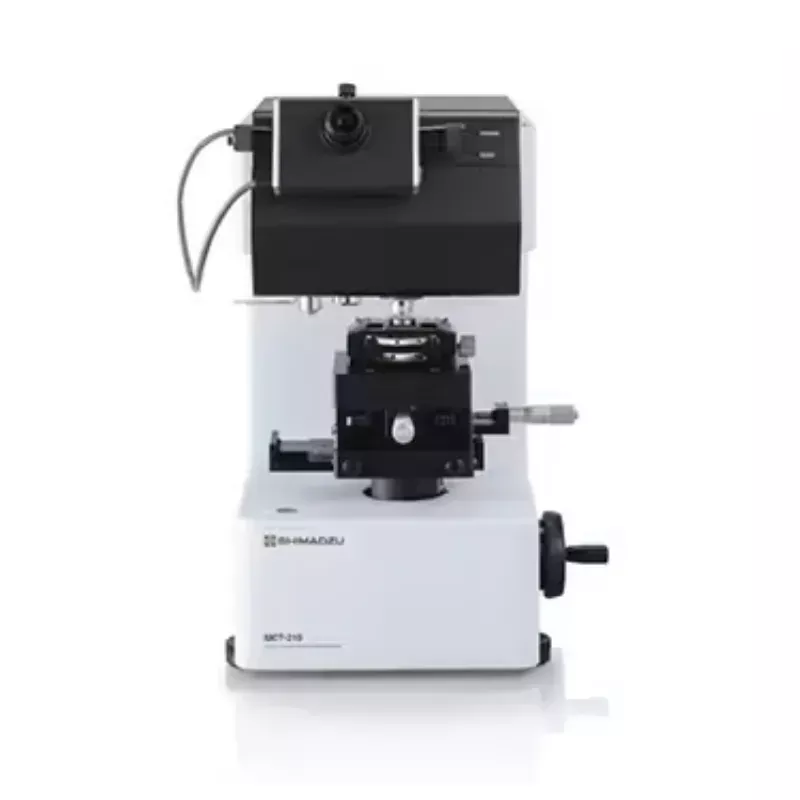
What Is Micromechanical Testing Equipment?
Micromechanical testing equipment includes specialized testing machines and measurement systems used to investigate the mechanical characteristics of microparticles, miniature components, fine fibers, and other small specimens. Such equipment applies controlled low forces, records microscopic displacements, and evaluates material behavior during deformation or fracture.
Micromechanical testing is used in powder metallurgy, materials science, ceramics manufacturing, electronic component production, polymers, pharmaceuticals, and composite materials research. It is particularly valuable when the properties of individual particles or microcomponents cannot be reliably determined using conventional universal testing machines.
Depending on the method and machine design, testing may include microcompression, microtension, repeated loading, and other forms of localized mechanical loading. These investigations employ sensitive sensors, precise positioning systems, optical observation equipment, and specialized specimen fixtures.
Microcompression Testing of Particles and Microcomponents
One of the principal methods for investigating small materials is Micro Compression Testing. During the test, an individual particle or microcomponent is positioned between a support surface and a loading indenter. The testing system gradually applies a compressive force and records the corresponding displacement until a specified load, deformation, or specimen failure is reached.
Unlike conventional compression testing, microcompression systems operate with forces that may be measured in millinewtons (mN) and displacements on micrometer and submicrometer scales. This enables investigation of individual particles ranging from a few to several hundred micrometers, depending on specimen geometry and equipment capabilities.
Microcompression testing may determine the following characteristics:
- Fracture force — the load at which an individual particle fractures or exhibits a defined failure event.
- Deformation under load — the amount of compressive displacement produced by a specified force.
- Force-displacement curve — the relationship describing specimen mechanical behavior during loading.
- Elastic recovery — the change in deformation after reducing or removing the applied load.
- Calculated compressive strength — a parameter derived from test results using specimen dimensions, shape, and an appropriate calculation method.
For irregular particles, porous granules, and heterogeneous materials, results must be interpreted with consideration of geometry, contact conditions, and fracture behavior. Particle fracture force cannot always be directly compared with the strength of the corresponding bulk material.
Loading Methods and Microdeformation Measurement
Micromechanical testing systems may operate in different modes depending on specimen properties and research objectives.
- Monotonic compression — gradual increase of force to a specified value or until specimen failure. This method is used to determine fracture force and deformation characteristics.
- Loading and unloading — sequential increase and decrease of force to evaluate shape recovery, permanent deformation, and other mechanical response characteristics.
- Repeated loading — application of a defined number of loading and unloading cycles to investigate the stability of specimen characteristics. Available cycle counts and testing modes depend on the specific machine.
- Dynamic micromechanical testing — investigation of small specimens under variable loads with controlled force, displacement, or frequency. Dedicated microtesting systems with suitable actuators and sensors are used for these applications.
Measurement accuracy depends on sensor resolution, specimen positioning, indenter geometry, and stability of the applied force. Optical observation helps determine particle dimensions, select the measurement area, and assess fracture behavior. Optional modules may provide image recording during testing and measurements under controlled temperature conditions.
Applications of Micromechanical Testing Equipment
Micromechanical methods are used to examine individual particles and components whose mechanical properties influence the behavior of finished materials or products.
- Powder metallurgy — evaluation of mechanical strength characteristics of individual metallic particles and granules under applied loads.
- Ceramics manufacturing — compression and fracture testing of ceramic microparticles, powders, and granulated materials.
- Pharmaceutical industry — investigation of mechanical stability of microcapsules, granules, and particles used in pharmaceutical manufacturing.
- Polymers and composites — examination of polymer particles, fillers, and fine fibers that may influence composite material properties.
- Electronics and microtechnology — mechanical testing of miniature components, materials, and specimens using suitable microtesting fixtures.
- Food and chemical industries — investigation of powders, pigments, granular ingredients, and other dispersed materials.
Testing individual particles is particularly important when a material requires a balance between mechanical durability and the ability to break down during processing. For example, granules may need to withstand transportation but fracture or disperse under specified processing conditions.
How to Choose Micromechanical Testing Equipment
When selecting equipment, important considerations include specimen type and dimensions, expected loads, displacement measurement resolution, force accuracy, and available testing modes. For microparticle testing, indenter design, precise positioning, and optical measurement of specimen geometry are especially important.
Microcompression testers are appropriate when the main objective is to assess the compressive strength of individual particles. Investigating fatigue life of miniature specimens requires systems capable of generating and controlling suitable cyclic loads. Local hardness or indentation measurements use separate microindentation techniques and should not be confused with particle compression testing.
Software functions for generating curves, calculating properties, storing results, and statistically comparing measurement series should also be considered. Properly selected micromechanical testing equipment supports characterization of small materials and components that are difficult to evaluate using conventional mechanical testing methods.