
Atomic Emission ICP Spectrometers
Inductively coupled plasma (ICP) emission spectrometers for highly accurate and sensitive elemental analysis.
What Are ICP Optical Emission Spectrometers?
Inductively Coupled Plasma Optical Emission Spectrometers (ICP-OES, also known as ICP-AES) are analytical instruments designed for qualitative and quantitative determination of chemical elements by optical emission spectrometry using an inductively coupled plasma. The technique enables multielement determination within a single sample, trace impurity analysis, and elemental composition control over a broad concentration range.
ICP-OES is used to analyze water, process solutions, food products, pharmaceutical raw materials, metals, alloys, geological samples, and environmental specimens after appropriate preparation. High-temperature argon plasma atomizes and excites the sample elements, while an optical system records their characteristic emission lines. This enables multielement analysis without requiring separate sequential measurements for every element.
Modern ICP emission spectrometers feature sensitive optical detectors, digital control systems, software for spectral processing, and automated sample introduction systems. The technique is particularly useful for laboratories that routinely need to determine major, alloying, and trace elements in different materials.
Operating Principle of Inductively Coupled Plasma Optical Emission Spectrometry
ICP-OES is based on detecting optical radiation emitted by atoms and ions excited in high-temperature argon plasma. Plasma is generated inside a quartz torch using a radio-frequency electromagnetic field that sustains argon ionization and transfers energy to particles of the sample material.
A typical analytical procedure includes several stages:
- Sample introduction — a liquid sample enters a nebulizer and is converted into a fine aerosol. The spray chamber removes larger droplets, allowing smaller droplets to reach the plasma.
- Atomization and excitation — high temperature causes solvent evaporation, compound decomposition, formation of free atoms, excitation, and partial ionization.
- Optical emission — excited atoms and ions emit light at characteristic wavelengths as they undergo transitions between energy levels.
- Spectral separation — the optical system disperses the emitted radiation into separate spectral lines corresponding to the elements being determined.
- Detection and quantification — the detector measures emission line intensity, and the software determines elemental concentrations using established calibration relationships.
The position of a spectral line identifies an element, while its intensity is related to concentration within an appropriate calibration range. Reliable results require control of spectral overlap, background emission, and physical or chemical interference caused by the sample matrix.
Analytical Capabilities and Plasma Viewing Systems
ICP optical emission spectrometers are used for multielement analysis, including determination of metals, metalloids, and selected nonmetallic elements. Depending on the analytical line, instrument sensitivity, and sample properties, both relatively high concentrations of major constituents and trace levels of impurities can be investigated. Detection limits in the µg/L range are achievable for some elements, but these values are not universal across all elements or sample types.
According to the plasma observation arrangement, spectrometers may employ axial and radial viewing systems:
- Axial plasma viewing — measures emission along the plasma torch axis. The longer optical path provides high sensitivity for many elements and is frequently selected for low-concentration measurements.
- Radial plasma viewing — measures emission from the side of the plasma. This configuration is often better suited to relatively high analyte concentrations and complex matrices because it can reduce certain spectral and matrix-related effects.
- Dual plasma viewing — provides access to both axial and radial observation modes in a single instrument. This enables selection of suitable conditions for different elements and extends the practical concentration range.
Modern multielement instruments may use echelle spectrometers equipped with semiconductor CCD detectors to record numerous spectral lines simultaneously. This reduces analysis time and allows alternative analytical wavelengths to be selected to minimize spectral interference.
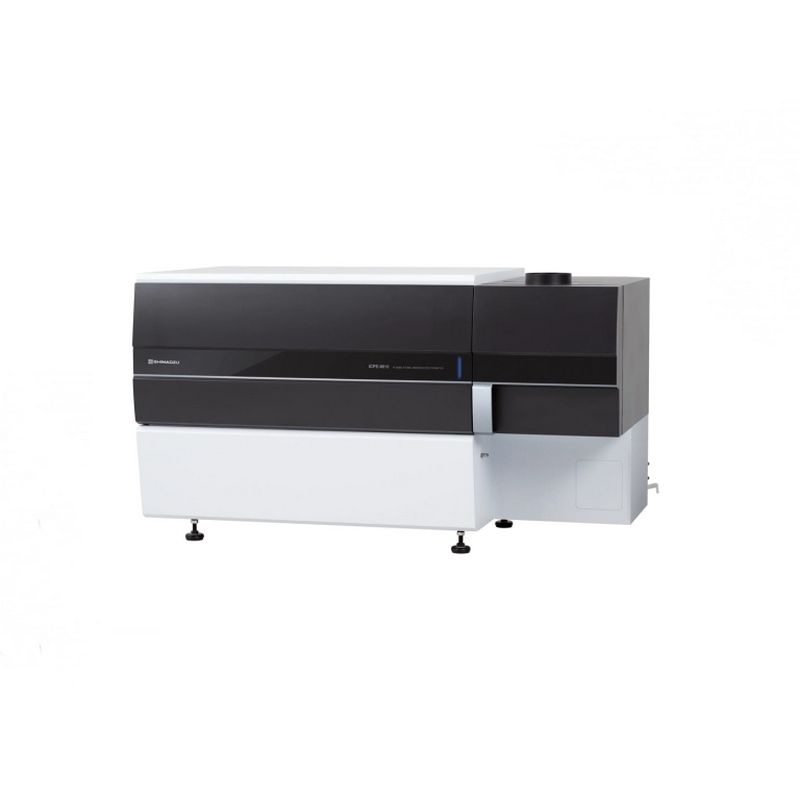
For example, the Shimadzu ICPE-9800 series includes the ICPE-9810 with axial plasma viewing and the ICPE-9820 with both axial and radial viewing capabilities. Available observation modes and analytical specifications depend on the specific model.
Sample Preparation, Calibration, and Elemental Analysis Accuracy
ICP-OES primarily analyzes liquid samples and prepared solutions. Water and process liquids may be measured after filtration, dilution, or acidification, depending on the analytical objective. Metals, alloys, soils, ores, food products, and other solid materials generally require suitable chemical digestion to transfer the elements of interest into solution.
Analytical accuracy depends on complete sample preparation, plasma stability, sample introduction efficiency, appropriate analytical wavelengths, and correctly prepared calibration standards. Matrix effects require particular attention, including high dissolved salt concentrations, organic constituents, and elements capable of producing overlapping spectral lines.
Quality assurance procedures include analytical blanks, calibration standards, internal standards, certified reference materials, signal stability monitoring, and mathematical correction of spectral interference. Standard addition procedures and specialized sample introduction systems may be used for challenging matrices.
High-salt, organic, or other nonstandard solutions may require dedicated nebulizers, spray chambers, torches, and accessories. These components must be selected according to sample properties and are not necessarily included in the standard instrument configuration.
One example of a standardized ICP-OES application is ISO 11885, which covers determination of selected elements in water. Suitability for a particular analytical procedure depends on the instrument configuration, sample preparation, and verified metrological performance.
Applications of ICP Optical Emission Spectrometers
Multielement ICP-OES analysis is widely used in laboratories that need to determine several or dozens of chemical elements in complex materials.
- Environmental monitoring — determination of metals and other elements in drinking water, natural water, wastewater, soils, sediments, and appropriately prepared environmental samples.
- Metallurgy and mechanical engineering — measurement of alloying elements and impurities in metals, alloys, process solutions, and chemically digested materials.
- Pharmaceutical industry — control of elemental impurities in raw materials, excipients, and finished products using established analytical procedures.
- Food and beverage industry — measurement of mineral constituents and unwanted elemental impurities in food products, beverages, and ingredients.
- Chemical and petrochemical industries — analysis of catalysts, additives, process media, lubricants, and chemical products.
- Geology and mining — elemental determination in ores, minerals, geological samples, and processed mineral materials after suitable preparation.
- Scientific research laboratories — development of multielement analytical methods, investigation of new materials, and verification of experimental samples.
ICP-OES is particularly useful when a wide range of elements at different concentration levels must be measured within one analytical procedure. However, ICP-MS may be preferable for ultratrace determination of selected elements, while spark optical emission spectrometry is more suitable for rapid direct analysis of solid metallic samples without converting them into solutions.
How to Choose an ICP Optical Emission Spectrometer
When selecting an ICP-OES spectrometer, important considerations include sample types, target elements, expected concentration levels, required detection limits, and laboratory throughput. For complex matrices, plasma stability, analytical line selection, interference correction, and sample introduction capabilities are particularly important.
The optical observation configuration also requires attention. Axial plasma viewing can be advantageous for determining low concentrations of many elements. Laboratories that routinely analyze higher concentrations or samples with widely varying elemental content may benefit from instruments supporting both axial and radial observation.
Other selection criteria include spectral range, detector performance, torch design, nebulizer type, autosampler compatibility, software functionality, and options for transferring results to laboratory information systems.
Operating considerations include argon consumption, ventilation, cooling, electrical power requirements, waste handling, and instrument maintenance. A properly selected ICP optical emission spectrometer provides reproducible multielement analysis and supports industrial quality control, environmental testing, and laboratory research.