
Spark Optical Emission Spectrometers
Spark optical emission spectrometers for rapid elemental analysis of ferrous and non-ferrous metals and alloys.
What Are Spark Optical Emission Spectrometers?
Spark Optical Emission Spectrometers (Spark OES) are analytical instruments designed for qualitative and quantitative determination of the elemental composition of solid metals and alloys using optical emission spectroscopy with spark excitation. These instruments provide rapid measurements of alloying constituents, major elements, and impurities in steels, cast irons, aluminum alloys, copper alloys, and other metallic materials.
Spark optical emission spectroscopy is widely used in metallurgy, foundries, mechanical engineering, automotive manufacturing, and quality control laboratories. The method enables chemical composition analysis of metallic specimens without prior dissolution, which is particularly valuable for production process monitoring, alloy grade identification, and incoming material inspection.
Unlike Inductively Coupled Plasma Optical Emission Spectrometry (ICP-OES), which generally analyzes liquids and prepared solutions, spark spectrometers operate directly on the surface of a solid metallic specimen. The analysis involves localized vaporization of a small amount of material, leaving a characteristic spark mark on the specimen surface.
Operating Principle of Spark Optical Emission Spectrometry
Spark optical emission spectrometry is based on excitation of material atoms and ions by an electrical discharge. A prepared metal specimen is placed on a spark stand, where a series of high-voltage pulses is generated between its surface and a counter electrode. Within the discharge region, a small amount of material is vaporized, atomized, and excited.
As excited atoms and ions return to lower energy states, they emit optical radiation containing characteristic spectral lines of chemical elements. The spectrometer's optical system separates this radiation by wavelength, while detectors measure the intensity of the relevant analytical lines.
A typical analytical procedure includes:
- Surface preparation — removal of contamination, oxide films, and surface irregularities that may affect discharge stability.
- Specimen positioning — placement of the metal sample on the spark stand, ensuring suitable contact and sealing of the discharge chamber.
- Spark excitation — generation of controlled electrical pulses that cause material vaporization, atomization, and excitation.
- Spectral detection — separation of emitted radiation and measurement of characteristic lines of the target elements.
- Quantitative calculation — determination of elemental mass fractions using calibration relationships established with reference materials of known composition.
Argon is frequently used to stabilize the discharge and reduce interference from atmospheric air. Controlling optical conditions is particularly important when measuring elements with spectral lines in the short-wavelength ultraviolet region, including carbon, phosphorus, and sulfur.
Analytical Capabilities and PDA Technology
Spark optical emission spectrometers support multielement analysis of metals and alloys. Depending on the optical system, analytical program, and calibration, major alloying constituents and impurities may be determined, including carbon, silicon, manganese, chromium, nickel, molybdenum, vanadium, copper, aluminum, phosphorus, and sulfur.
The available elements and their measurement ranges depend on alloy type and instrument configuration. Different calibration programs are required for steels, cast irons, and non-ferrous alloys because the base material can influence discharge formation and spectral signal intensity.
Shimadzu PDA spectrometers employ Pulse Distribution Analysis (PDA), a technique based on recording and statistically processing emission signals from individual spark pulses. This approach helps account for differences in material excitation, monitor measurement stability, and improve result reproducibility under suitable analytical conditions.
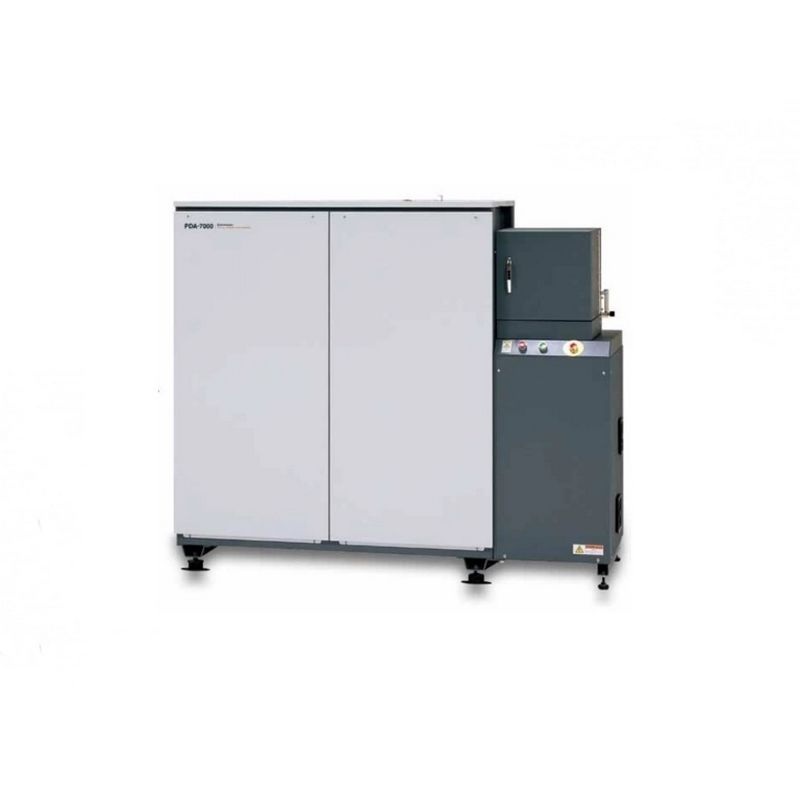
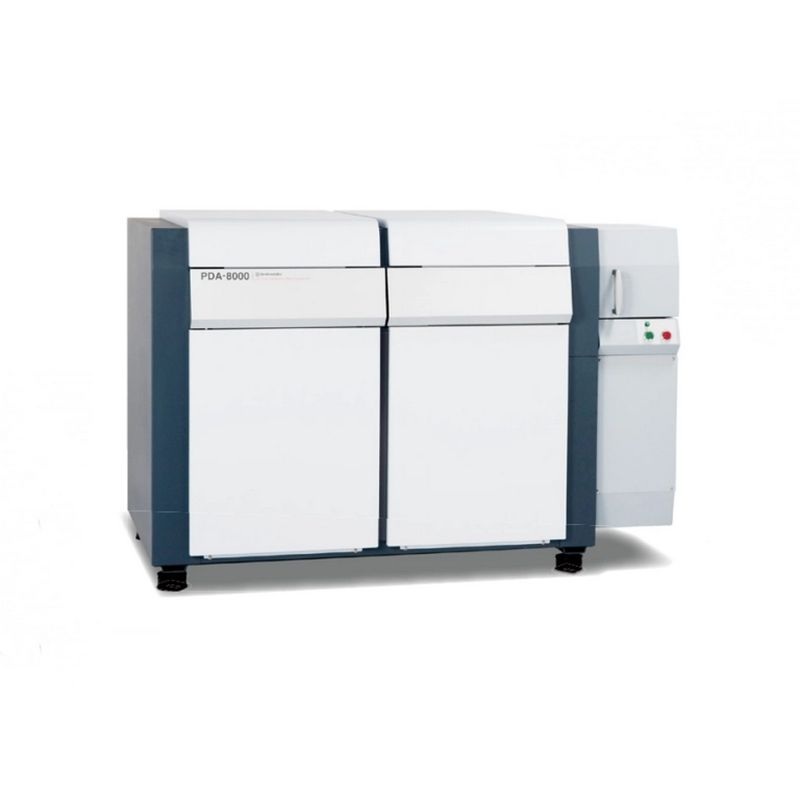
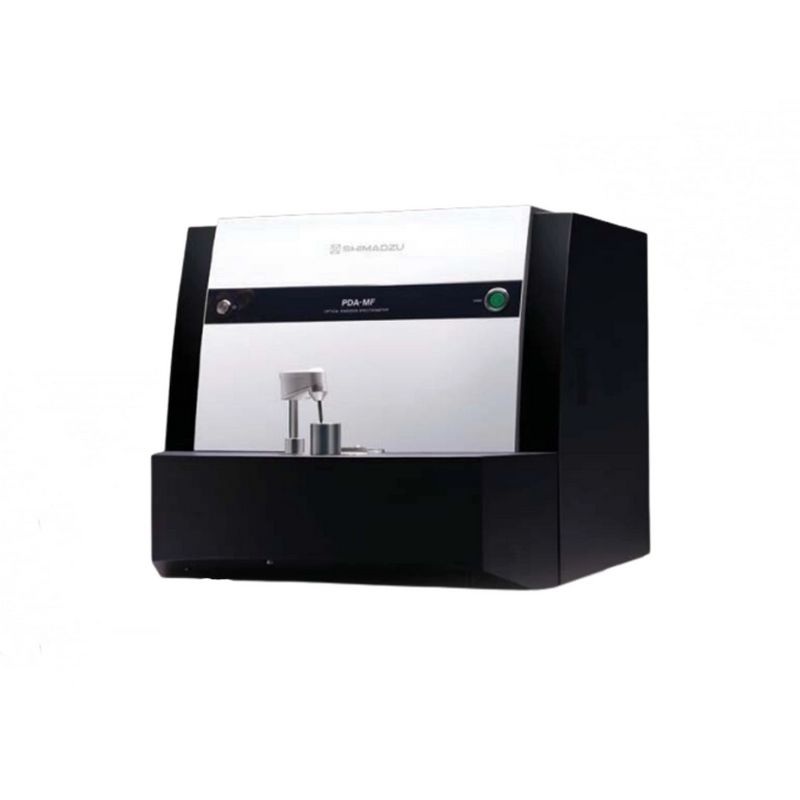
Instrument designs may include vacuum monochromators, diffraction gratings, photomultiplier tubes or CCD detectors, digital discharge monitoring, and software for result processing. For example, Shimadzu PDA-7000 and PDA-8000 spectrometers incorporate dedicated optical systems and PDA analysis, while the compact PDA-MF and PDA-MF PLUS models use CCD detectors and are designed for rapid metallic specimen inspection.
Automatic alloy identification systems may compare measured elemental concentrations with databases of metal grades. The reliability of such identification depends on database coverage, measurement quality, and how closely the actual material composition matches the specified grade limits.
Specimen Preparation and Analytical Accuracy
Proper surface preparation is one of the most important factors influencing the reliability of spark spectrometric analysis. The test area must be sufficiently flat, clean, and suitable for a stable electrical discharge. Oxide films, lubricants, contamination, irregularities, and material inhomogeneity can cause deviations in analytical results.
Metal specimens are prepared using grinding machines, abrasive discs, milling, and other machining techniques. The appropriate preparation method depends on the material and analytical procedure. For example, the surface preparation of a steel specimen may differ from that required for aluminum or copper alloys.
Thin sheets, wires, small components, or irregularly shaped specimens may require specialized clamping fixtures and optional spark stand accessories. Standard instrument configurations cannot necessarily accommodate every specimen geometry without additional preparation.
Quantitative analysis requires calibration using reference materials with elemental compositions representative of the sample matrix. Calibration verification, signal drift monitoring, electrode cleaning, and spark chamber maintenance are performed to maintain measurement stability.
Standardized methods for metals and alloys include ASTM E415 for carbon and low-alloy steels and ASTM E1251 for aluminum and its alloys. Suitability for a particular standard depends on the spectrometer's analytical capabilities, configuration, and implemented procedure.
Applications of Spark Optical Emission Spectrometers
Spark optical emission spectroscopy is used for rapid elemental composition control of solid metallic materials in industrial production and laboratory analysis.
- Metallurgy and steel production — determination of alloying elements and impurities, melt composition monitoring, and verification of metal chemistry at different production stages.
- Foundries — analysis of cast iron, steel, and non-ferrous alloys, inspection of cast samples, and verification of compliance with process requirements.
- Mechanical engineering and metalworking — incoming inspection of rolled metal products, steel grade verification, and analysis of blanks, components, and structural materials.
- Automotive manufacturing — elemental analysis of alloys used for engines, transmissions, housings, and other components.
- Aerospace and power generation industries — investigation of specialty alloys and materials subject to demanding chemical composition requirements.
- Metal recycling — identification and sorting of metallic materials by alloy grade using appropriate analytical programs.
- Quality control laboratories — multielement analysis, material certificate verification, and monitoring of chemical composition consistency between production batches.
The method is particularly useful where rapid analytical results are needed without time-consuming chemical digestion. However, conventional spark spectrometry is not a universal technique for nonmetallic, liquid, or powder samples without specialized preparation.
How to Choose a Spark Optical Emission Spectrometer
Instrument selection should begin with identifying the metals and alloys to be analyzed, target elements, expected concentration levels, and required detection limits. For ferrous materials, the ability to determine carbon, phosphorus, sulfur, and other elements affecting steel and cast iron properties is especially important.
Key specifications include spectral range, optical resolution, spark stand design, excitation source stability, detector technology, and available calibration programs. Facilities working with different metallic materials should verify compatibility with multiple alloy families and automatic grade identification capabilities.
Compact instruments may be suitable for routine production inspection and analysis of various metal grades. Systems with more advanced optical performance and discharge control are appropriate for demanding applications, including the determination of low concentrations of selected impurities.
Operating requirements such as argon consumption, power supply, installation space, specimen preparation, calibration, and maintenance must also be considered. A properly selected spark optical emission spectrometer provides reproducible elemental composition measurements, supports product quality control, and enables rapid verification of metallic materials in laboratory and production environments.