
Differential Scanning Calorimeters
Instruments for measuring heat effects accompanying physicochemical processes in materials during heating or cooling.
What Are Differential Scanning Calorimeters?
Differential Scanning Calorimeters (DSC) are laboratory instruments used to investigate thermal properties of materials and physical or chemical processes involving heat absorption or release. Differential Scanning Calorimetry provides information about melting, crystallization, glass transitions, transition enthalpies, curing reactions, and specific heat capacity when appropriate measurement procedures are applied.
DSC instruments are widely used in materials science, polymer manufacturing, the chemical and pharmaceutical industries, food production, electronics, and research laboratories. They support material comparisons, process development, production batch inspection, and determination of temperature intervals associated with changes in sample thermal properties.
Unlike thermogravimetric analyzers, which record mass changes, differential scanning calorimeters measure thermal effects. This enables the detection of transitions that may occur without a corresponding mass change, such as melting, crystallization, or glass transition. DSC results may be combined with thermogravimetry, spectroscopy, and other analytical methods for more comprehensive material characterization.
Operating Principle of Differential Scanning Calorimetry
DSC is based on measuring differential heat flow associated with a sample and reference position during a controlled temperature program. The sample and reference are placed in suitable pans, and the system applies programmed heating, cooling, or isothermal conditions.
In heat-flux DSC, the sample and reference positions are exposed to a common thermal environment. Their thermal response is measured and converted into differential heat-flow data using the calibrated measurement system. When a material undergoes a phase transition or chemical reaction, heat may be absorbed or released, producing a characteristic change in the DSC signal.
The result is a DSC curve, displaying heat flow as a function of temperature or time. Endothermic and exothermic peaks, baseline changes, and other features can be evaluated to characterize the corresponding thermal processes.
A typical testing procedure includes:
- Sample preparation — determining a suitable sample mass and placing the material in an appropriate pan.
- Temperature programming — selecting starting and final temperatures, heating or cooling rates, and isothermal hold periods.
- Atmosphere selection — using a suitable inert or oxidizing gas environment depending on the analytical objective.
- Heat-flow recording — continuously measuring the DSC signal throughout the temperature program.
- Data evaluation — determining transition temperatures, integrating peaks, calculating enthalpy, and preparing reports.
Observed thermal effects depend on material properties, sample mass, heating rate, pan design, and other conditions. Results should therefore be interpreted in relation to the selected procedure and the material's thermal history.
What Properties Can DSC Instruments Determine?
Differential Scanning Calorimetry is used for quantitative and comparative analysis of thermal transitions and heat-related processes. Depending on the sample and method, the following properties may be evaluated:
- Melting temperature (Tm) — the temperature or interval associated with an endothermic transition caused by melting of a crystalline phase.
- Crystallization temperature (Tc) — a parameter describing the exothermic formation of crystalline structures under an appropriate temperature program.
- Glass transition temperature (Tg) — a characteristic of the transition between glassy and more mobile states in amorphous material regions, usually observed as a baseline change related to heat capacity.
- Transition enthalpy — the heat associated with melting, crystallization, or another process, obtained by integrating the corresponding thermal event.
- Polymer crystallinity — a calculated property estimated from melting enthalpy, relevant reference values, and any cold crystallization occurring during the measurement.
- Curing enthalpy — the heat associated with polymerization or crosslinking reactions, used to investigate processing behavior.
- Specific heat capacity (Cp) — a thermal property determined using appropriate calibration and dedicated measurement procedures.
- Thermo-oxidative behavior — characteristics of oxidation processes measured under specified atmospheric and temperature conditions.
DSC can reveal differences between materials and the effects of previous thermal processing. However, it does not directly provide complete chemical composition, sample mass loss, or guaranteed long-term service-life information. Additional analytical procedures may be required for such purposes.
Shimadzu DSC-60 PLUS and DSC-60A PLUS Calorimeters
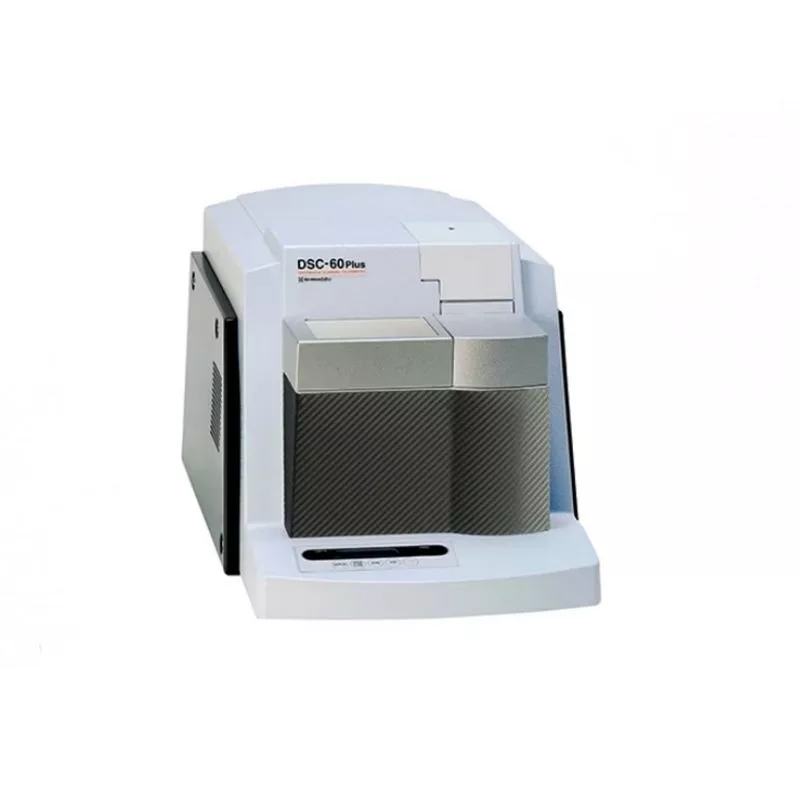
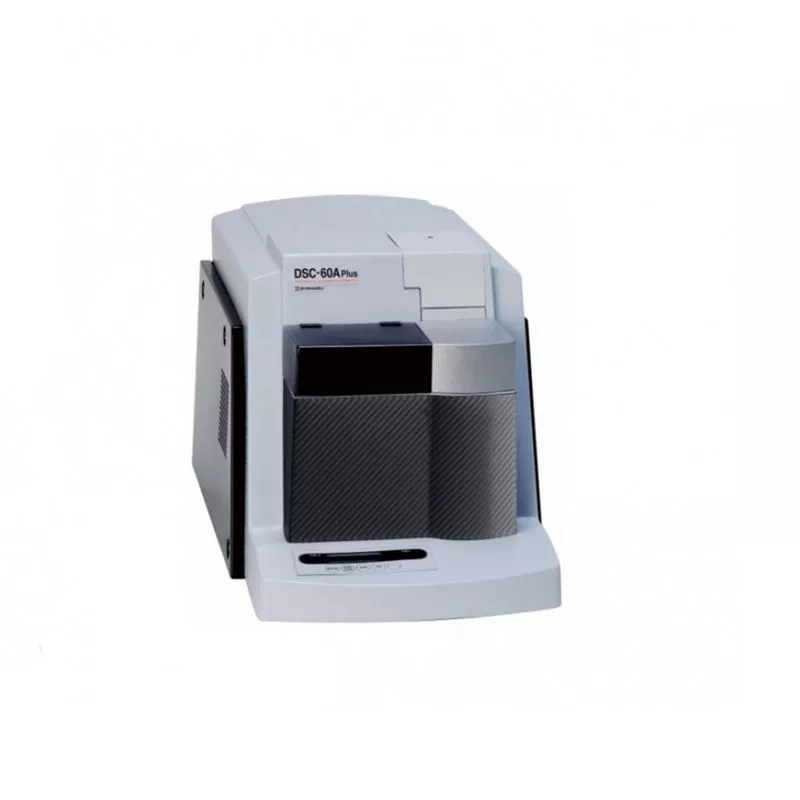
Shimadzu DSC-60 PLUS and DSC-60A PLUS are high-sensitivity differential scanning calorimeters intended for thermal characterization in quality control laboratories and research facilities.
Both models use the heat-flux DSC measurement principle and operate from −140 to +600 °C when liquid nitrogen is used for low-temperature analysis. Without liquid nitrogen, the operating range begins at room temperature. Their heat-flow measurement range is ±150 mW, allowing investigation of thermal effects of different intensities.
The series provides a stable baseline and low measurement noise. According to the manufacturer, baseline noise does not exceed 0.5 µW RMS under specified conditions at 150 °C. Various sample pans, gas atmospheres, and additional cooling accessories may be used according to analytical requirements.
The key difference between the two models is sample handling:
- Shimadzu DSC-60 PLUS — a differential scanning calorimeter with manual sample loading, designed for thermal transition analysis, calorimetric studies, and material characterization using programmed temperature methods.
- Shimadzu DSC-60A PLUS — an automatic model featuring a built-in sample changer with capacity for up to 24 samples. It supports unattended series of measurements and automated data processing.
Temperature-Modulated DSC (TM-DSC) is available as an optional feature for the series. It superimposes a periodic temperature modulation on the underlying temperature program and can help separate overlapping thermal phenomena and measure heat capacity using appropriate procedures.
The DSC-60A PLUS is therefore particularly suitable for laboratories processing many specimens, while the DSC-60 PLUS is appropriate where automatic sample changing is not required.
Sample Preparation and DSC Measurement Accuracy
Reliable DSC results depend on specimen preparation, sample pan selection, temperature programming, gas atmosphere, and instrument calibration. Suitable sample quantities and consistent thermal contact with the measuring system are important.
Open, closed, or hermetically sealed sample pans may be used depending on the material and test conditions. For volatile substances, potential pressure increases inside sealed pans must be considered. Not all pan designs are suitable for every temperature range or chemical reaction.
Aluminum and other sample pan materials are available for DSC measurements, provided they are compatible with the specimen and temperature program. Additional accessories may include sealing tools, atmosphere flow controllers, and dedicated cooling equipment.
Heating and cooling rates can influence observed transition temperatures, peak shapes, and the extent of reaction processes. Different programs may affect polymer crystallization behavior or the apparent progress of curing reactions. Consistent test conditions are therefore necessary for meaningful material comparisons.
Temperature and heat-flow calibration is performed using suitable reference materials and established procedures. The ISO 11357 series covers DSC of plastics, including ISO 11357-2 for glass transition, ISO 11357-3 for melting and crystallization, and ISO 11357-4 for specific heat capacity. Suitability for a particular standard depends on instrument capabilities, accessories, and verified calibration.
Industrial Applications of Differential Scanning Calorimetry
DSC instruments are used to investigate thermal properties in industrial laboratories, scientific institutions, and quality control facilities.
- Polymer manufacturing — measurement of glass transition, melting, and crystallization temperatures of plastics, thermoplastics, elastomers, and polymer composites.
- Pharmaceutical industry — examination of thermal transitions in active pharmaceutical ingredients, polymorphic behavior, excipients, and pharmaceutical formulations.
- Chemical industry — investigation of reaction heat, polymer resins, adhesives, coatings, and reactive mixtures.
- Food industry — characterization of fat melting and crystallization, food ingredient thermal behavior, and raw material properties.
- Electronics — testing encapsulants, adhesives, solder-related materials, and other components using suitable temperature programs.
- Composite manufacturing — monitoring polymer matrix curing, residual reaction enthalpy, and thermal transitions.
- Materials science — comparison of new materials, examination of phase transitions, and evaluation of previous thermal processing.
- Research laboratories — development of calorimetric methods and investigation of the thermal behavior of experimental materials.
DSC curves can support production batch comparisons, process verification, and evaluation of material differences. Correct interpretation requires consideration of sample composition, thermal history, and measurement conditions.
How to Choose a Differential Scanning Calorimeter
DSC instrument selection should begin with the materials being tested, expected transition temperatures, heat-flow signal levels, required heating and cooling modes, and sample throughput.
Low-temperature applications may require liquid nitrogen or a compatible automatic cooling attachment. High-temperature analysis requires verification of the upper operating limit, sample pan material, and permissible gas atmospheres.
For laboratories conducting large numbers of similar measurements, an instrument with an autosampler, such as the DSC-60A PLUS, may be advantageous. Research applications may place greater emphasis on baseline stability, low noise, temperature control, special calorimetric methods, and advanced software analysis.
Other selection criteria include sample pan availability, calibration materials, atmosphere control, software features, data archiving, and maintenance requirements. A properly selected differential scanning calorimeter provides reproducible thermal measurements and supports material research, quality control, and product development.