
Analytical Balances and Moisture Analyzers
Precision laboratory balances and instruments for measuring moisture content in various samples.
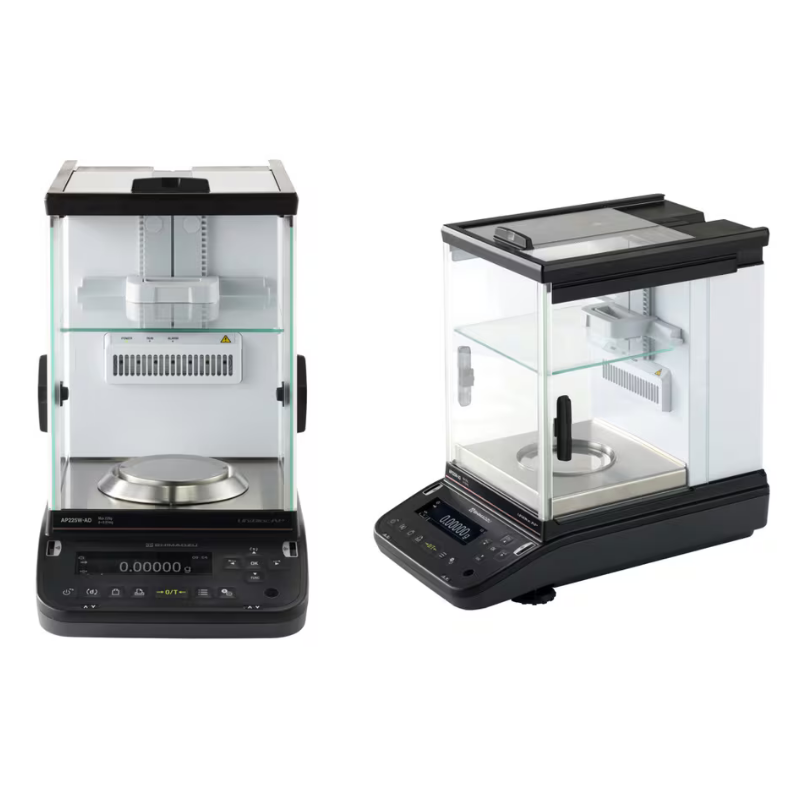
Analytical balances, AP124W
Shimadzu (Japan)
Analytical balances, AP124X
Shimadzu (Japan)
Analytical balances, AP124Y
Shimadzu (Japan)
Analytical balances, AP125WD
Shimadzu (Japan)
Analytical balances, AP125WD-AD
Shimadzu (Japan)
Analytical balances, AP135W
Shimadzu (Japan)
Analytical balances, AP135W-AD
Shimadzu (Japan)
Analytical balances, AP224W
Shimadzu (Japan)
Analytical balances, AP224W-AD
Shimadzu (Japan)
Analytical balances, AP224X
Shimadzu (Japan)
Analytical balances, AP224Y
Shimadzu (Japan)
Analytical balances, AP225W
Shimadzu (Japan)
Analytical balances, AP225W-AD
Shimadzu (Japan)
Analytical balances, AP225WD
Shimadzu (Japan)
Analytical balances, AP225WD-AD
Shimadzu (Japan)
What Are Analytical Balances and Moisture Analyzers?
Analytical balances and moisture analyzers are laboratory instruments designed for precise determination of specimen mass and investigation of material mass loss during drying. They are used in pharmaceutical, chemical, and food manufacturing, materials science, research institutions, and quality control laboratories.
Analytical balances are intended for weighing small quantities of substances, preparing specimens and solutions, and performing quantitative laboratory procedures. Moisture analyzers combine precision weighing with controlled specimen heating to determine mass loss according to an established analytical method. Both types of instruments play an important role in achieving reproducible laboratory measurements.
Analytical Balances: Operating Principle and Capabilities
Modern electronic analytical balances use highly sensitive weighing mechanisms, including electromagnetic force compensation systems. They detect small changes in mass and display measurement results digitally. Analytical balances are generally equipped with draft shields to protect measurements from air movement.
Depending on their design and configuration, laboratory balances may support:
- Precision weighing — mass determination with readability specific to each model. A readability of 0.1 mg is common for analytical balances, while dual-range semi-microbalances may provide 0.01 mg readability within a designated weighing range.
- Internal or external adjustment — correction of balance indications using built-in or external calibration weights. Certain instruments support automatic adjustment in response to temperature changes or according to a scheduled time.
- Additional weighing functions — percentage weighing, piece counting, checkweighing, and other calculation-based operations.
- Data transfer and storage — communication with computers, printers, or laboratory information systems when suitable interfaces are available.
It is important to distinguish readability, repeatability, and measurement accuracy: a large number of displayed decimal places does not by itself guarantee reliable results. Weighing performance is affected by vibration, air currents, temperature, electrostatic charges, calibration, and correct instrument installation.
Moisture Analyzers: The Thermogravimetric Drying Method
Laboratory moisture analyzers use the thermogravimetric loss-on-drying (LOD) method. The specimen is weighed before and during heating, and the instrument calculates its relative mass loss. Depending on instrument design, heating may be provided by halogen heaters or infrared quartz heaters.
These systems are used to examine powders, granules, pastes, food products, pharmaceutical raw materials, chemical substances, and other materials suitable for thermal drying. Available measurement programs may include standard, rapid, gentle, or stepwise heating. The analysis may terminate after a specified time or when mass change meets a predefined stability criterion.
Importantly, thermogravimetric analysis determines total mass loss during drying, not exclusively the amount of water. If other volatile substances evaporate or the specimen undergoes thermal decomposition, the result may differ from the actual water content. Drying temperature, heating time, and termination criteria must therefore be selected according to specimen properties and the established analytical procedure.
Applications of Analytical Balances and Moisture Analyzers
These instruments are used in laboratories requiring precise mass measurement, sample preparation, or determination of material mass loss during drying.
- Pharmaceutical manufacturing — weighing active substances and excipients, preparing analytical specimens, and controlling raw material characteristics.
- Chemical industry — solution preparation, reagent dosing, powder characterization, and loss-on-drying determination.
- Food industry — ingredient weighing and moisture assessment of grain products, flour, starch, food ingredients, and finished products.
- Agriculture — laboratory examination of grain, feed, plant materials, and other agricultural products.
- Materials science and scientific research — specimen preparation, weighing small amounts of substances, and investigating material characteristics.
How to Choose an Analytical Balance or Moisture Analyzer
When selecting an analytical balance, important parameters include maximum weighing capacity, readability, repeatability, linearity, minimum acceptable sample mass for the intended application, and adjustment capabilities. Stabilization time, draft shield design, communication interfaces, and operating environment requirements should also be considered.
For moisture analyzers, key selection criteria include maximum sample capacity, heater type, temperature range, available drying programs, mass-loss measurement resolution, and data storage capabilities. Compatibility between the analytical method and the material is particularly important because heat-sensitive substances, specimens containing volatile compounds, and heterogeneous materials may require special measurement conditions.
Properly selected analytical balances and moisture analyzers provide reproducible laboratory measurements and support quality control according to industrial and scientific research requirements.