Description
The Shimadzu AIRsight infrared/Raman microscope combines infrared and Raman microscopy to characterize microscopic sample regions. Both techniques can be applied on a single microscope stage without moving the sample, allowing IR and Raman spectra to be compared at the same position. These complementary methods support the identification of polymers, pigments, foreign particles, and other organic and inorganic components.
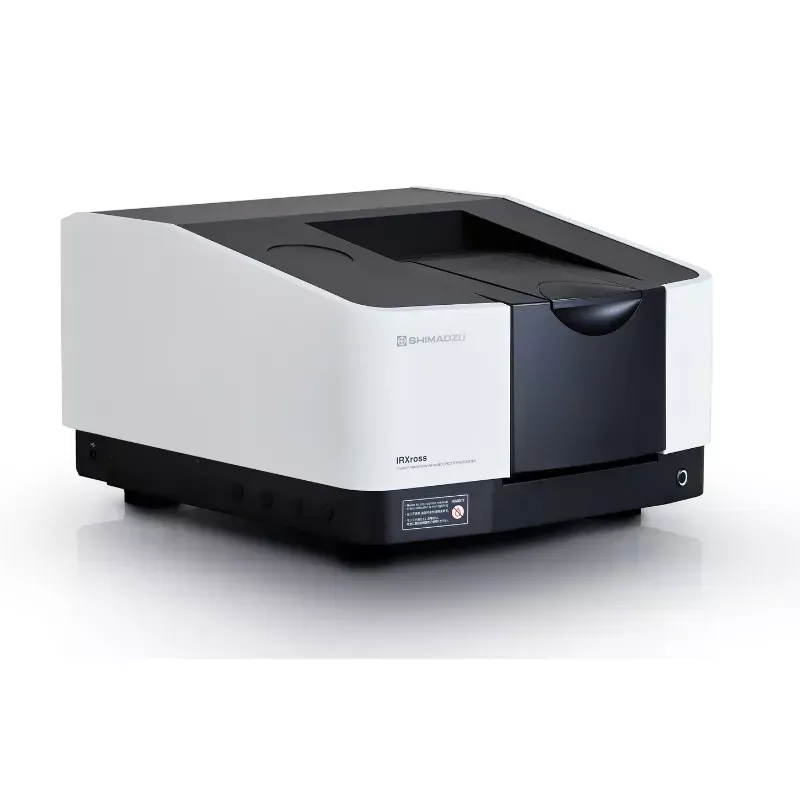
For infrared measurements, AIRsight is used with a compatible Shimadzu Fourier transform infrared spectrophotometer, such as the IRXross or IRTracer-100. Its Raman module features confocal optics and two excitation lasers at 532 and 785 nm. AMsolution software supports acquisition, visualization, and comparison of both types of spectra without repositioning the sample.
Features
- Infrared and Raman microscopy on the same sample stage, enabling analysis of the same microscopic location.
- 532 and 785 nm excitation lasers for selecting Raman measurement conditions according to sample properties.
- Confocal Raman optics for small-area analysis and depth profiling.
- Wide-field and microscope cameras for viewing samples and selecting measurement positions.
- Standard T2SL infrared detector requiring liquid nitrogen; an optional TEC MCT detector enables measurements without liquid nitrogen.
- IR and Raman line and area mapping, plus Raman depth profiling.
- AMsolution software for acquiring, comparing, and analyzing IR and Raman spectra.
Applications
- Identification of microscopic contaminants and foreign particles.
- Analysis of polymers, multilayer materials, and coatings.
- Investigation of pigments, additives, carbon materials, and composites.
- Quality control in chemical, electronics, and engineering industries.