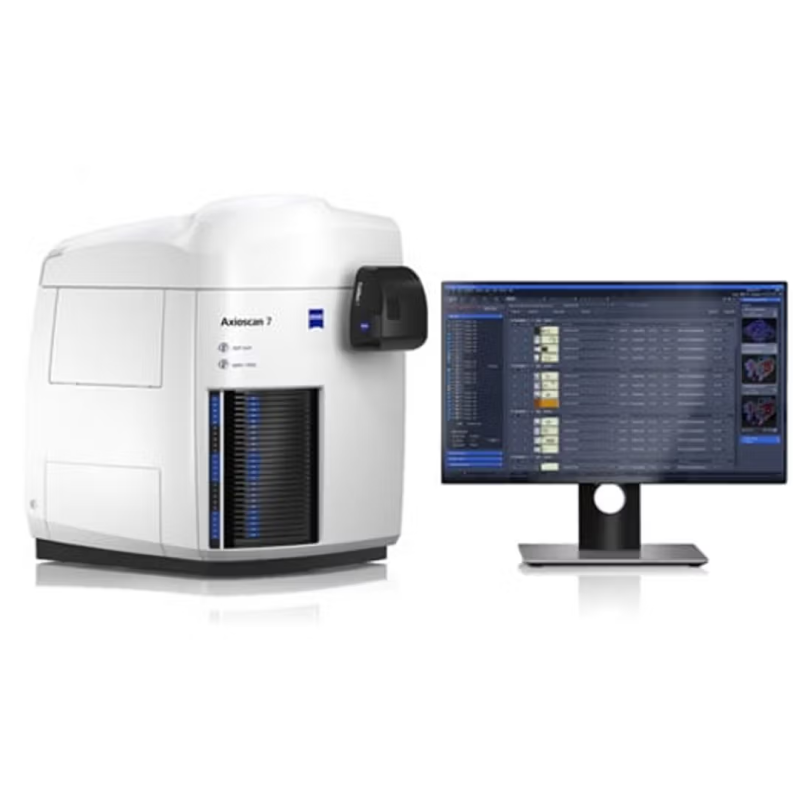
Description
ZEISS Celldiscoverer 7 is a fully automated cell imaging system designed for high-quality live-cell visualization and multiparametric cellular studies. It combines ease of use, intelligent automation, and experimental flexibility to deliver reproducible and statistically reliable data.
The system enables both fast live-cell experiments and complex long-term multiparametric studies. With integrated autofocus, calibration, and environmental control, Celldiscoverer 7 minimizes user influence and ensures consistent image quality even in long-duration experiments.
Key Features
- Fully automated workflow — from sample loading to image acquisition
- High data acquisition speed: up to 9× faster than widefield and up to 1.8× faster than confocal microscopy
- Support for multiple imaging modes: widefield, fluorescence, label-free methods, and optional confocal imaging
- Compatibility with various sample formats: Petri dishes, multi-well plates, and chamber slides
- Flexible experiment setup and automated workflows
Technologies
- Automated sample recognition: detection of carrier type and optical properties
- Autocorr: automatic spherical aberration correction for improved contrast and image quality
- Find Focus / Definite Focus: fast focus acquisition and stable focus maintenance during experiments
- Autoimmersion Module: automatic immersion media delivery for long-term live-cell experiments
- LED illumination: up to 7 different excitation wavelengths for multiparametric fluorescence imaging
- LSM 910 + Airyscan (optional): confocal and super-resolution 3D imaging
- Integration with ZEISS arivis Pro: advanced 2D/3D/4D image analysis and large data processing
Applications
- Live-cell imaging and long-term time-lapse experiments
- Cell population screening and multiparametric analysis
- Multicolor fluorescence studies
- 3D and confocal imaging of cells and tissues
- Analysis of dynamic processes (FRAP, FRET, photomanipulation)
Benefits
- Ease of use: automated parameter setup without advanced expertise
- Reproducibility: consistent and comparable results independent of the user
- Flexibility: combination of multiple imaging modes within a single experiment
- Automation: minimal user intervention even in complex workflows
- Reliability: stable performance in multi-user environments and long-term experiments
- Scalability: efficient handling of large datasets and sample series